NEWS 8 IS YOUR LOCAL ELECTION HEADQUARTERS…. AND TONIGHT…VOODOO ECONOMICS! CHIEF POLITICAL CORRESPONDENT MARK DAVIS TELLING US HOW REPEALING THE STATE INCOME TAX IS THE LATEST HEATED TOPIC BETWEEN THE CANIDATES FOR GOVERNOR.
DEMOCRAT NED LAMONT IS OPENING A NEW FRONT IN HIS BATTLE AGAINST REPUBLICAN BOB STEFANOWSKI, CALLING HIS PLAN TO CUT AND ELIMINATE THE INCOME TAX, ‘VOODOO ECONOMICS.’
[LAMONT] “AS MOST OF THE REPUBLICANS SAID ABOUT BOB’S PLAN TO ELIMINATE THE INCOME TAX, QUOTE, ‘IT’S AN EMPTY PROMISE.’”
HE SAYS THE CENTRAL STEFANOWSKI CAMPAIGN PROMISE WOULD BE A DISASTER, CUTTING FUNDING FOR EDUCATION, VETERANS, THE ELDERLY AND CAUSE UPWARD PRESSURE ON LOCAL PROPERTY TAXES AS HAPPENED IN KANSAS WHEN A SIMILAR PLAN WAS LAUNCHED FIVE YEARS AGO AND LATER REVERSED.
[LAMONT] “NOT ONLY DID IT DEVASTATE SERVICES, NOT ONLY DID IT MEAN GREAT INCREASES IN THE PROPERTY TAX, BUT IT LEAD TO ENORMOUS UNCERTAINTY IN THE BUSINESS COMMUNITY.”
IN THE PRIMARY ELECTION, REPUBLICANS STEVE OBSITNIK, TIM HERBST, AND MOST NOTABLY DAVID STEMERMAN ALL SAID ELIMINATING THE INCOME TAX WAS NOT POSSIBLE. AND THE STATE’S HIGHEST RANKING ELECTED REPUBLICAN HAS EXPRESSED SIMILAR VIEWS. HERE’S WHAT HOUSE MINORITY LEADER THEMIS KLARIDES TOLD A RADIO INTERVIEWER THE WEEK BEFORE THE PRIMARY ABOUT ELIMINATING THE INCOME TAX.
[KLARIDES ON WNHH] “THERE IS NO WAY, AS SOMEBODY THAT HAS BEEN IN THOSE BUDGETS, THE DEVELOPING OF THE BUDGETS, THE ARGUING OF THE BUDGETS, THE DEFENDING OF THE BUDGETS, IN THEM 24/7 FOR THE PAST COUPLE OF YEARS, THERE IS NO WAY TO FIND THAT MONEY NOW.”
[LAMONT] “THEMIS HAS BEEN THERE. SHE’S BEEN IN THE TRENCHES. SHE KNOWS HOW TOUGH IT IS TO BALANCE THIS BUDGET.”
BOB STEFANOWSKI HAD TWO EVENTS TODAY. THE NEWS MEDIA WAS NOT ALLOWED AT EITHER ONE OF THEM.
LIVE, FROM THE HARTFORD NEWSROOM, MARK DAVIS, NEWS 8 LIVE, FROM THE HARTFORD NEWSROOM, MARK DAVIS, NEWS 8.
Shortly after taking office, President Barack Obama’s secretary of education, Arne Duncan, acknowledged that America’s public school system is broken. “It’s obvious the system’s broken,” he said. “Let’s admit it’s broken, let’s admit it’s dysfunctional, and let’s do something dramatically different, and let’s do it now. Let’s fix the thing.”
Why are America’s public schools failing? Why, after more than a quarter century of perpetual reform, has the nation been unable to bring real change to public education? While a complete answer, of course, would be very complicated. But at the heart of it lies the power of the teachers unions — the National Education Association, the American Federation of Teachers, and their state and local affiliates.
I don’t say this out of some sort of anti-union ideology. I say it as an objective description of the reality, backed by an enormous amount of data. Union power has created insurmountable problems for effective schools.
Why has this happened? Partly, it’s because the teachers unions are by far the most powerful groups in American education. More than that, they are special interest groups, which means that they use their power to promote the special interests — the job interests — of their members. They are not in the business of representing the interests of children, and no one should expect them to do that.
The purpose of a union is to represent the job interests of its members — and these interests are simply not the same as the interests of children. How, then, do they pursue these job interests? They do it in two ways.
The first is through collective bargaining, which takes place in local school districts. Through collective bargaining, the unions are able to win countless restrictive work rules, written into binding contracts that specify how the schools must be organized. Typically, for example, these contracts include salary rules requiring that teachers be paid entirely on the basis of seniority and credentials, without any regard for whether their students are actually learning anything.
Often, these contracts also include seniority rules that allow senior teachers to take desirable jobs when they come open — even if these teachers are mediocre in the classroom or a bad fit for the school. There are also seniority rules requiring that, in layoff situations, excellent young teachers must be let go — automatically — and their senior colleagues must be kept on no matter how incompetent they may be. Labor contracts are just filled with these kinds of perverse rules. No one who’s thinking only of what is best for kids would ever organize the schools in this way. Yet this is how America’s schools are actually organized.
The other way teachers unions shape the public schools is through the political process — where they simply have far more clout than any other education groups, by many orders of magnitude. They have over four million members, they’re top contributors to political campaigns, they have armies of activists in the electoral trenches, they have lobbying organizations in all fifty states, and much more.
They have used this political clout to block or substantially weaken major reforms.
For decades, for example, reformers have tried to bring accountability to America education, but the unions have stood in the way.
They’ve opposed using test scores to measure teacher performance. They’ve opposed performance-based pay. They have even opposed moving bad teachers out of the classroom. As a result, there are rarely any consequences for low performance — no one’s pay suffers, no one loses a job. We have accountability systems in which no one is actually held accountable when kids don’t learn.
The unions have also fiercely opposed the second major reform movement of our time: the movement for school choice — which seeks to give families new options, to empower them to leave bad schools, and to give the regular public schools stronger incentives to improve. Here, too, the unions fight for their members, not for students and their families, in this case because school choice allows children — and thus money and jobs — to leave the schools where union members teach.
Indeed, the unions are so opposed to choice that they fight to defeat it even for the poorest kids trapped in the nation’s worst schools. As a result, after decades of reform efforts, only 4% of public school kids are in charter schools, and less than 1% receive government funded scholarships for private schools.
But here’s what it comes down to. The teachers unions have used their power from the bottom up, through collective bargaining, to burden the schools with organizations that are literally not designed to be effective. And they’ve used their power from the top down, through politics, to stand in the way of accountability, choice, and other major reform efforts.
As Arne Duncan well expressed, the nation is fully aware that it has a problem with its public schools. But the main reason that problem persists is that there’s another problem, a more fundamental one that prevents real change and improvement — the problem of union power. Until the nation is able to recognize that problem — and do something about it — America’s public schools will never be organized to provide kids with the most effective education possible.
I’m Terry Moe, Professor of Political Science at Stanford University, for Prager University.
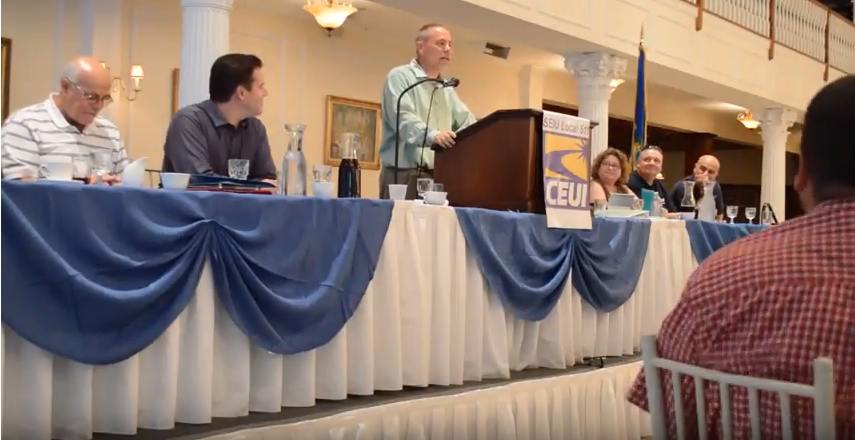
Speaker of Connecticut House of Representatives, Joe Aresimowicz, speaking at the 2014 CEUI Convention: transcript
Joe Aresimowicz: He just said A to Z because he didn’t want to try Aresimowicz, and I’m glad he didn’t so.
First and foremost, good afternoon, brothers and sisters. How are we going today, alright? I always start this off, yes I do have a position as House Majority Leader and the State Representative from Berlin and Southington. And I am really proud of that, and I have a great job, and I’m able to help people in my district on a daily basis and also help people statewide.
But more importantly I’m a twenty-three year member and dues-paying member of AFSCME, which leaves me almost ready to retire, including time if I would add this duty which I worked at directly to protect your rights. That’s the most important aspect of my career. I would give up the political side of it in a minute and keep working to protect union members rights on a daily basis in the State of Connecticut. So that’s why I always agree with the brothers and sisters, and we talked about that.
Now I know some of you have seen a video tape of me cruising around on the internet. No, not that kind. The one from the Wisconsin presentation that we did in Middletown. I don’t know how many you know the story so I am going to boil it down a little bit for you here today. But I think we need to talk about it. Because I went to Wisconsin right after Governor Walker was elected. I went out there when the bill was cruising its way through their General Assembly thinking what can I do. On my own time I went out there and started knocking on doors.
I spent a long time in the Capitol. One of the days that I was there it was announced either a quarter of a million to a half a million people circling outside the capitol and also inside the capitol. For me being a life-long union member, and as my cousin can tell you that my father was fired for trying to organize a union. So that’s all I’ve ever known. It was probably one of the most powerful moments in my life, and you know, you get the little bumps on the back of your neck, your hair standing up, we’re chanting, we’re caring signs: I thought we were taking over the capitol.
So I straddled up to this gentleman, he was wearing a red shirt that said Wisconsin educator, so it was either college or school, and he started talking about what we were doing there. And I said, “Brother, this is the greatest moment I have ever been involved in my life. We finally said as union members, enough is enough: we’re not going to take it anymore.” And the guy looked over at me and said where are you from, and I said from Connecticut. I am AFSCME member. Well, AFSCME member from Connecticut, the fight we already lost. We’re not rallying because we’re pissed off. But when we could have avoided it in April, May, June, July, August, September, October, and I was begging all of my members to get actively involved in this campaign, because I told them all what was at risk, I heard every story in the world. I heard that my son’s got a ball game. My aunt’s sick. My grandmother has this. So Mr. AFSCME from Connecticut, thanks a lot coming out but my members gave away their rights, and they did it in the months leading up to the election.
So what I thought was a great moment actually kind of humbled me a little bit. So one of the things that I swore to myself was that I was not I’m going to let it happen here in Connecticut. That at least I would do as many tours of this statem including Middletown, CSEA Locals, AFSCME, CEUI, anybody I could talk to, to ensure that that would never happen in Connecticut.
Now come April May June July August of this year, if I told you with 18 days to go it was a dead heat, that our rights were quite possibly going to be protected for the next four years, at least, I think you would take that bet. I think you would look at yourself in the mirror and say, sure because right now it doesn’t look that way because the Governor’s office is in jeopardy, the Senate was in jeopardy, and even my chamber, the House: we’re looking at possibly losing seats.
You guys have one of your own that sits in the caucus room of the General Assembly. You cannot replicate that. The reason I originally ran for office is Dennis O’Neil begged me to run for office because too many times the door closes on that Caucus. And even the smiles and the claps on your back, “don’t worry, we got your back.” And that door closes and somehow you come out and your back doesn’t feel so comfortable anymore. And maybe they went a little lower in your back. And that’s reality.
So you’ve Russ over there in Wethersfield that is one of your members, that when the negotiations are tough, when you’re on the menu instead of being at the table, he’s there to ensure that he is that back stop. He’s in a tough race. Eighteen days to go, if half of this room goes out and door knocks his district, he wins by a landslide. And talks to the members about the issues that are important to you.
Same thing for the Gubernatorial race. Eighteen days, eighteen days to decide whether you keep your collective bargaining rights because as much as he says he was talking about chambers and agreeing, we know exactly what Tom Foley wants: his Wisconsin moment. And if you really don’t believe it, come with me the rest of the day, I’ll hang out and talk to you, all the little articles I’ve seen, all the things he said, a lie, he really means that.
We want collective bargaining and not collective begging. Eighteen days. Please don’t let me stand up outside the Connecticut capitol and have the same conversation with an individual this time with a Connecticut t-shirt on. I’m talking about how nobody turned up, and how this moment didn’t necessarily have to happen. The last thing we need is a Wisconsin moment in Connecticut. Absolute last thing. I say at all these meetings and groups that I talk to I will never allow an anti-collective bargaining bill to be called to the House floor. I’m the Majority Leader. I can make that guarantee.
If I’m the Minority Leader, not so much. All I can do is I’ll talk as long as I can to avoid them running that bill. So a lot of things are at stake. You know, I know you’ve been hearing it at night and I know at some point we say enough is enough. The numbers of the polls look better, the House will be okay, the Senate is going to be okay, the gubernatorial is a tossup.
I beg of you, I begged, I begged, and I beg again: please don’t allow us to wake up on November 5th, open up your newspaper and realize that because we needed to do what we needed to do in eighteen days, we’re now having to take to the streets. We’re now having to rally at the capitol. There’s a lot at stake. I beg you to get involved in Russ’s campaign, call up your local committees who are working the phones. Get out and get to work. It’s eighteen days to ensure we have benefits for the near future.
You guys have a great evening, proud members, you made this state what it is. Don’t let it go away with one election. Please stand together, stand as brothers and sisters, and be a family and make sure we are looking out for our own. Thank you.
[End of speech by Joe Aresimowicz.]
[We attempted to transcribe this speech as accurately as possible but due to the quality of the audio, please be advised of imperfections. We apologize for any errors; please advise of any necessary corrections.]